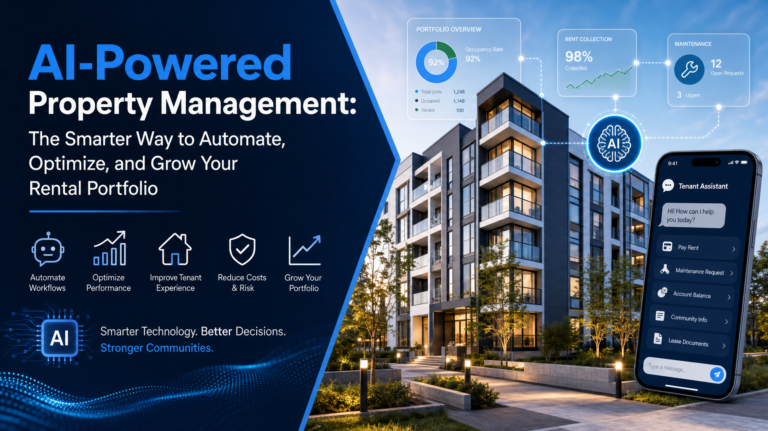
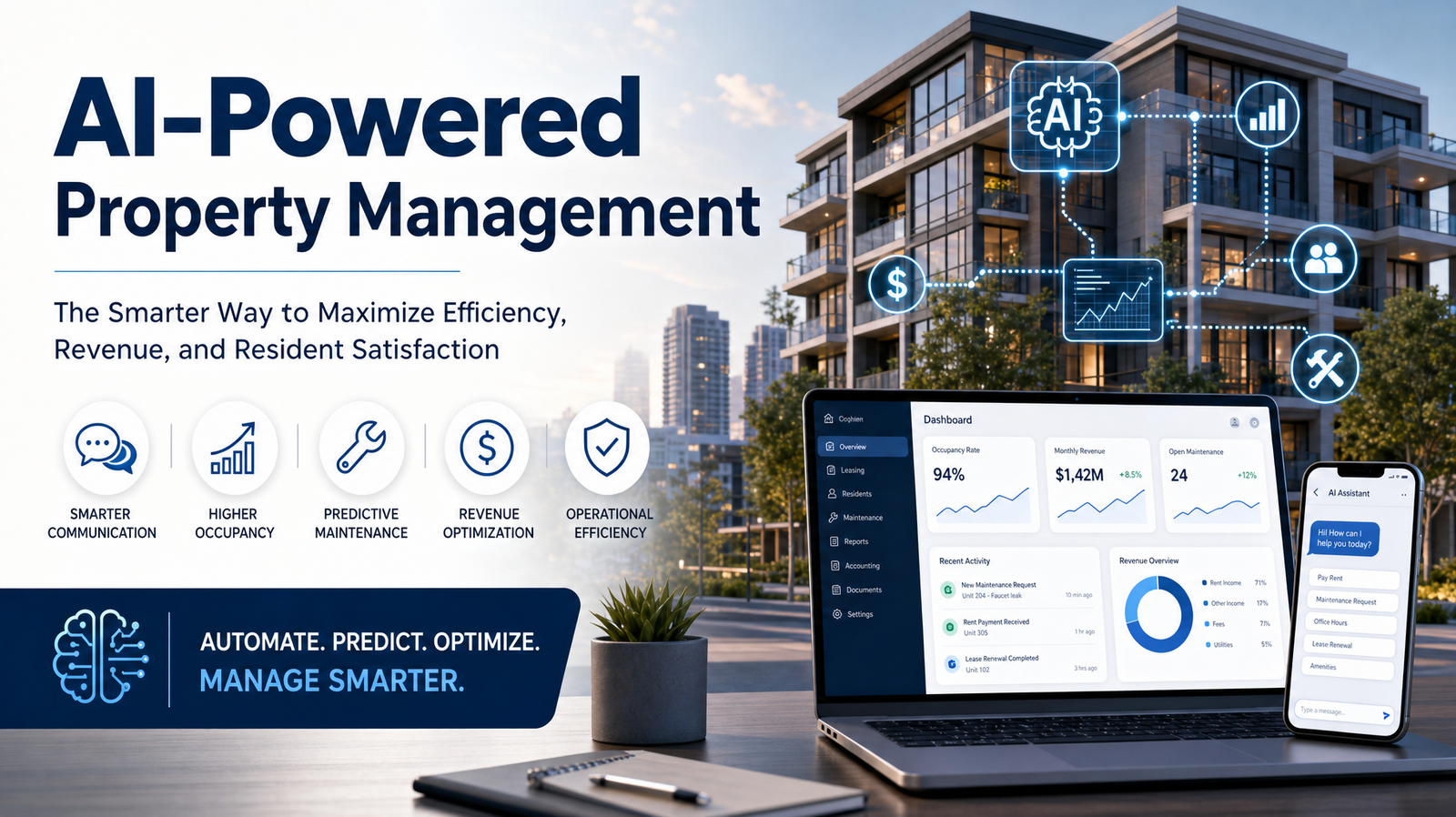
AI-Powered Property Management: The Smarter Way to Maximize Efficiency, Revenue, and Resident Satisfaction
The property management industry is undergoing a major transformation. From automated leasing workflows to predictive maintenance and intelligent tenant communication, AI-powered property management is helping property owners and managers operate more efficiently while delivering a better resident experience. What once required hours of manual administration can now be streamlined with artificial intelligence, machine learning, and advanced property management software.
For residential communities, multifamily portfolios, commercial buildings, and vacation rentals, AI is no longer a futuristic concept. It is becoming a practical business tool for reducing costs, improving occupancy rates, responding faster to maintenance requests, and making data-driven decisions.
What Is AI-Powered Property Management?
AI-powered property management uses artificial intelligence technologies to automate routine tasks, analyze large volumes of data, and support better operational decisions. These systems can assist with everything from tenant screening and rent collection to leasing communication, building maintenance, accounting, and compliance monitoring.
Unlike traditional property management platforms that primarily store information and organize workflows, AI-enabled systems can identify patterns, make recommendations, predict outcomes, and take action based on predefined rules. This creates a more proactive and responsive approach to managing properties.
Common technologies used in intelligent property management include:
- Machine learning for forecasting occupancy, revenue, and maintenance needs
- Natural language processing for AI chatbots and resident support
- Computer vision for property inspections and damage detection
- Predictive analytics for identifying operational risks
- Automation tools for leasing, payments, notifications, and reporting
- Internet of Things sensors for monitoring energy use, temperature, and equipment performance
How Artificial Intelligence Is Changing Property Management
1. Faster and More Personalized Tenant Communication
Residents expect quick, convenient, and accurate communication. AI chatbots and virtual assistants can answer common questions about rent payments, lease terms, amenities, office hours, and maintenance procedures at any time of day. This reduces response times and allows property managers to focus on complex issues that require human attention.
AI-powered communication tools can also personalize messages based on a resident’s preferences, lease status, payment history, or service requests. Automated reminders can be sent for lease renewals, inspections, late payments, community events, and scheduled maintenance without requiring staff to manage every interaction manually.
2. Smarter Leasing and Lead Conversion
Leasing teams often lose prospective renters when inquiries are answered too slowly. AI property management platforms can respond to leads instantly, qualify prospects, schedule property tours, recommend available units, and provide follow-up messages across multiple channels.
By analyzing lead behavior, an AI system can help identify which prospects are most likely to convert. It can also recommend the best time to follow up and determine which property features or floor plans may be most relevant. This improves leasing efficiency and can increase occupancy without requiring a larger leasing team.
3. Predictive Maintenance and Lower Repair Costs
Traditional maintenance is often reactive. A resident reports a broken appliance or a building system fails, and the property team responds after the problem has already occurred. Predictive maintenance changes this model by using historical work orders, equipment data, sensor readings, and usage patterns to identify potential failures before they happen.
For example, an AI system may recognize that a heating unit is showing performance patterns associated with an upcoming breakdown. The property manager can schedule service proactively, preventing emergency repairs, reducing disruption, and extending the equipment’s useful life.
AI can also categorize incoming maintenance requests by urgency, assign tasks to the appropriate vendor, and monitor completion times. This creates a more organized maintenance workflow and improves resident satisfaction.
4. More Accurate Rent Optimization
Setting the right rental price is essential for maximizing income while remaining competitive. AI-powered rent optimization tools evaluate market trends, local demand, seasonality, property features, historical occupancy, competitor pricing, and neighborhood conditions.
Instead of relying solely on intuition or outdated spreadsheets, property managers can use real-time insights to make informed pricing decisions. These systems may recommend rent adjustments, identify underperforming units, and estimate how pricing changes could affect occupancy and revenue.
Responsible use of AI is especially important in pricing. Property owners should select tools that support transparent, compliant, and fair housing practices, with human oversight built into the decision-making process.
5. Streamlined Rent Collection and Financial Operations
Late payments, manual reconciliations, and fragmented financial records create unnecessary administrative work. AI-enabled property management software can automate payment reminders, detect unusual transaction activity, categorize expenses, reconcile accounts, and generate financial reports.
Automated accounting workflows help property managers maintain more accurate records and identify cash flow trends. AI can also flag potential discrepancies, duplicate charges, or unusual vendor invoices for review. This saves time while giving owners greater visibility into portfolio performance.
Benefits of AI-Powered Property Management
The advantages of adopting AI extend across the entire property management operation. The most significant benefits include:
- Improved efficiency: Repetitive administrative tasks are completed faster with fewer manual steps.
- Reduced operating costs: Automation and predictive maintenance help lower labor, repair, and energy expenses.
- Higher resident satisfaction: Faster responses, convenient self-service tools, and proactive support improve the tenant experience.
- Better decision-making: Real-time analytics provide a clearer view of occupancy, income, expenses, and operational risks.
- Increased revenue: Intelligent pricing, improved lead conversion, and reduced vacancy can strengthen financial performance.
- Greater scalability: Property teams can manage more units without increasing administrative workload at the same rate.
AI Tools Property Managers Should Consider
There is no single AI solution that fits every portfolio. The right technology depends on property type, portfolio size, staffing model, and business goals. Useful capabilities to evaluate include AI leasing assistants, automated tenant portals, predictive maintenance software, smart building systems, intelligent document processing, fraud detection, and portfolio analytics.
Integration is also important. An AI platform should connect with existing accounting systems, customer relationship management tools, access control systems, payment processors, marketing platforms, and maintenance software. Strong integrations prevent data silos and give property managers a unified view of operations.
Challenges and Considerations Before Adoption
Although AI offers substantial benefits, implementation requires careful planning. Data quality is one of the biggest considerations. Inaccurate, incomplete, or inconsistent records can lead to unreliable recommendations. Organizations should establish clear data management standards before depending on automated insights.
Privacy and security are equally important. Property management systems handle sensitive information, including identification documents, financial data, lease records, and communication histories. Managers should choose vendors with strong encryption, access controls, transparent data policies, and appropriate compliance practices.
Human oversight should remain part of the process. AI can support decisions, but it should not replace empathy, professional judgment, or accountability. Property teams should regularly review automated decisions, monitor results for bias, and ensure that technology is used consistently with housing laws and company policies.
How to Implement an AI Property Management Strategy
- Identify operational bottlenecks: Determine which repetitive processes consume the most time or create the most errors.
- Set measurable goals: Choose targets such as shorter response times, lower maintenance costs, higher occupancy, or faster rent collection.
- Start with a focused use case: Begin with one area, such as tenant communication or maintenance scheduling, before expanding across the organization.
- Evaluate technology providers: Compare integrations, security features, reporting capabilities, ease of use, and customer support.
- Train the property team: Employees need clear guidance on how AI tools work, when to intervene, and how to interpret recommendations.
- Measure performance: Track results against the original goals and refine workflows based on real-world outcomes.
The Future of Intelligent Property Management
The future of property operations will be increasingly connected, predictive, and automated. Smart buildings may use real-time sensor data to optimize energy consumption, detect water leaks, and adjust indoor environments. AI assistants will become more capable of handling complex resident requests, while property managers will use predictive analytics to plan budgets, staffing, capital improvements, and portfolio growth.
However, the strongest property management strategies will combine technology with human service. AI can process information and automate workflows at scale, but successful property management still depends on trust, communication, responsiveness, and strong relationships.
By adopting AI thoughtfully, property owners and managers can create more efficient operations, more profitable portfolios, and better places to live. AI-powered property management is not simply a software upgrade; it is a strategic approach to building a smarter, more responsive, and more sustainable real estate business.